Saturday, September 6, 2014

Beginners Guide To The Saigon Bus System (Written By A Beginner)

One of the first things I did after we got settled in here in Ho Chi Minh City was to try to figure public transportation out. I grew up in Boston and lived in the NYC area for six years (two of them without a car), so I am pretty comfortable using public transportation in the US.

Most of my co-workers either own a motorbike, or share cabs for getting around. And these are both good options in Saigon. Motorbikes are by far the most common form of transport, and cabs are prett affordable compared to most other cities. I'm still deciding about whether I'll get a motorbike, but I'm taking my time making the decision. In the meantime, I take the bus.


Since my job started, I've been riding the bus to and from work, and I have also taken buses to a some other destinations. I've got a long way to go before I am an expert (or anything close), but I thought it might be helpful to share what I have learned so far, starting with the real basics.

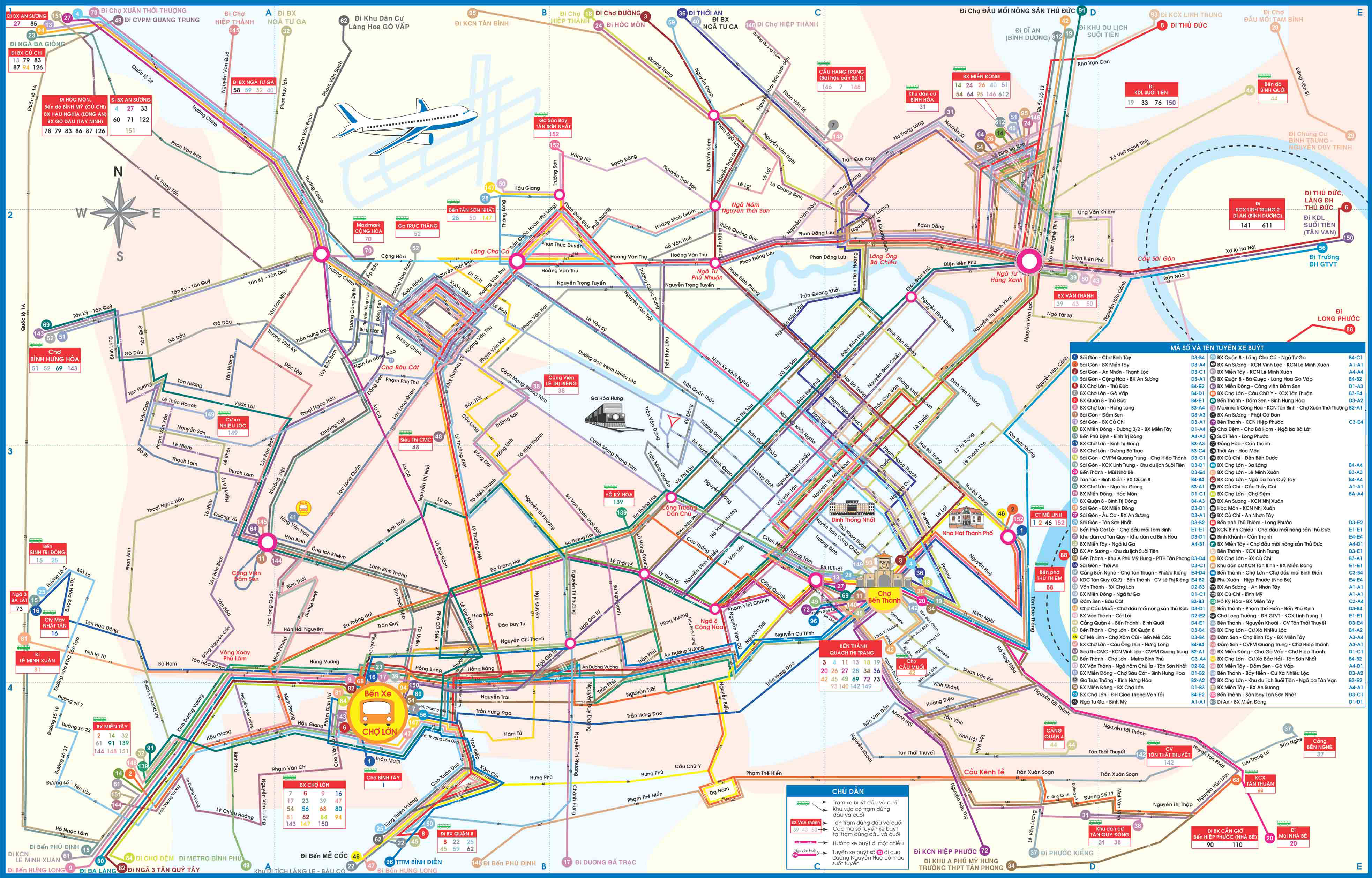
First of all, the Saigon Bus System is huge. How big, you ask? You can find a map here. Go ahead, take a look.

Yeah, that big.

The good news is that the buses run frequently, and are very inexpensive. A ride costs around $.25 US. The frequency of buses means that I get a seat most of the time, even during rush hour. The buses are generally clean and while I've heard people mention issues of petty crime, I haven't witnessed any problems of that nature.

The main drawback I find is that the system can be a bit daunting, and I have to figure a lot of it out by trial-and-error. The bus maps don't always accurately show current routes, and sometimes a bus will do its pickup at an odd location such as a couple of blocks from the bus station rather than at the station itself. Also, the buses don't generally run at night.

So, how do you take the bus?

Well, you start by finding a bus stop.

Some stops have signs that are pretty clearly marked.


Some bus stops have a full shelter and bench setup.


 But in some cases, the stop is just marked on the street, like this:


The Vietnamese word for bus is xe buýt. It's important to recognize bus stops because the buses don't necessarily stop at every corner, and the will generally not stop for a person trying to flag them down between stops.


 This would also be a good place to mention something that came up in a previous blog entry. The term "bus stop" should not be taken to mean that the bus will actually come to a complete stop. It's more of a "bus-slow-down-sufficiently-for-you-to-jump-on-board".

The buses that I've been on cost either 5,000 or 6,000 VND. The exchange rate is around 20,000 VND to the US dollar, so a ride on the bus will set you back about a quarter.

How you deal with paying depends on the crew arrangement of the bus. Some buses have a two-person crew. Look for someone sitting near the back door of the bus holding packs of tickets and guiding people to seats. If there is a ticket-taker, then you should sit down and the ticket-taker will come to you. If there is not, then you should pay the driver. Watch what the other passengers are doing for cues.

Exact change is a really good idea on the bus. It's less of an issue on a bus with a dedicated ticket-taker, but you still don't want to try to pay with too big a bill. If you're trying to pay the driver, you will probably be handing him money while he has one hand on the steering wheel and the other on the shift. The buses are all standard shift, and the driver is often collecting money and handing out tickets while shifting gears and maneuvering among hundreds of motorbikes on a busy city street. Least can do is to not make the guy try to count out change for you.

When you pay your fare, you will get a ticket.


 Hold onto it. Occasionally a "bus inspector" will get on board at a stop and check everone's ticket to make sure they're paid up. If you buy a ticket and misplace it, you could find yourself kicked off the bus or be made to pay the fare again.

In addition to the bus stops, there are some large bus stations around the city. The one that I change buses at every day is Ben Thanh.


The bus station can be confusing because the locations labeled with bus numbers are not always the correct place to get that bus. The bus station workers will help direct you, and can communicate in English sufficiently to get their point across. Some buses don't actually depart from the station itself. Instead, they have a stop a block or two away. This is just something you need to figure out by asking or by observing the bus that you are looking for. Fortunately, the buses run frequently enough that if you miss getting your bus because you're standing in the wrong part of the station, you shouldn't have to wait too long for another bus on your route. I find generally that you don't have to wait more than 10 minutes for a bus.

When you're on the bus, there is usually some sort of button to alert the driver when you want to get off at the next stop. There are a lot of different buses, with the stop signals in different places, but I find there is almost always one near the back door.


 Some bus etiquette: In Vietnam, the attitude seems to be that no one should stand on the bus unless every possible seat is full. Ticket-takers will usher people into seats, and as soon as seats free up, standing riders are expected to sit. Seats toward the front are marked to be give up for elderly, disabled, etc., but this isn't always perfectly put into practice.

When getting off the bus, people tend to use the back door, but this is not completely consistent.

As mentioned at the beginning of this entry, I'm still a beginner at this, but I've found traveling around Ho Chi Minh City by bus to be reliable and cheap, and it can be fun to look out the window and watch the city while you leave the driving to the Saigon Bus System.


Sunday, August 31, 2014

The View From Above: Saigon Skydeck

The tallest and most distinctive building in Ho Chi Minh City is the 68-floor Bitexco Financial Tower. On floor #49 is the Saigon Skydeck, with a 360-degree birds-eye view of the city. Admission is about $10 US, which is pretty good compared to comparable attractions in other cities.

Yesterday I took the Kiddo to have a look at the city from this vantage point. We took the bus in to District 1 and walked from the Ben Thanh bus station.


It's pretty easy to figure out where to go, as the Bitexco Tower is a rather distinctive landmark.


The tower's first four floors house an upscale mall, a movie theater, and a food court where we stopped for lunch, figuring the food at the cafe on the 50th floor would probably be overpriced. Food court proved to be quite good.


The Skydeck has its own entrance, so we headed back out to the street, taking a moment to look up.


From there, it was up the "fastest elevator in Southeast Asia" and up to check out the view.

It was pretty spectacular.


We got a different view of some familiar places.

Ben Thanh Market.


And the Ben Thanh Bus Station.


The world-famous Majestic Hotel.


Which does not actually look all that majestic from this angle.


(We've been inside it, though, and it is quite lovely).

Here's another of Saigon's famous hotels, the Rex (foreground left), along with Saigon City Hall.


Boats on the Saigon River.


And some views of the city, stretching to the horizon.


 This cluster of buildings includes the Lan Lan 2 Hotel, where we stayed when we first arrived in Vietnam.


The foot-bridge over a branch of the river.


Another view of City Hall.


After making our way down the elevator, we visited some of the sites we had seen from above to check them out at street level.

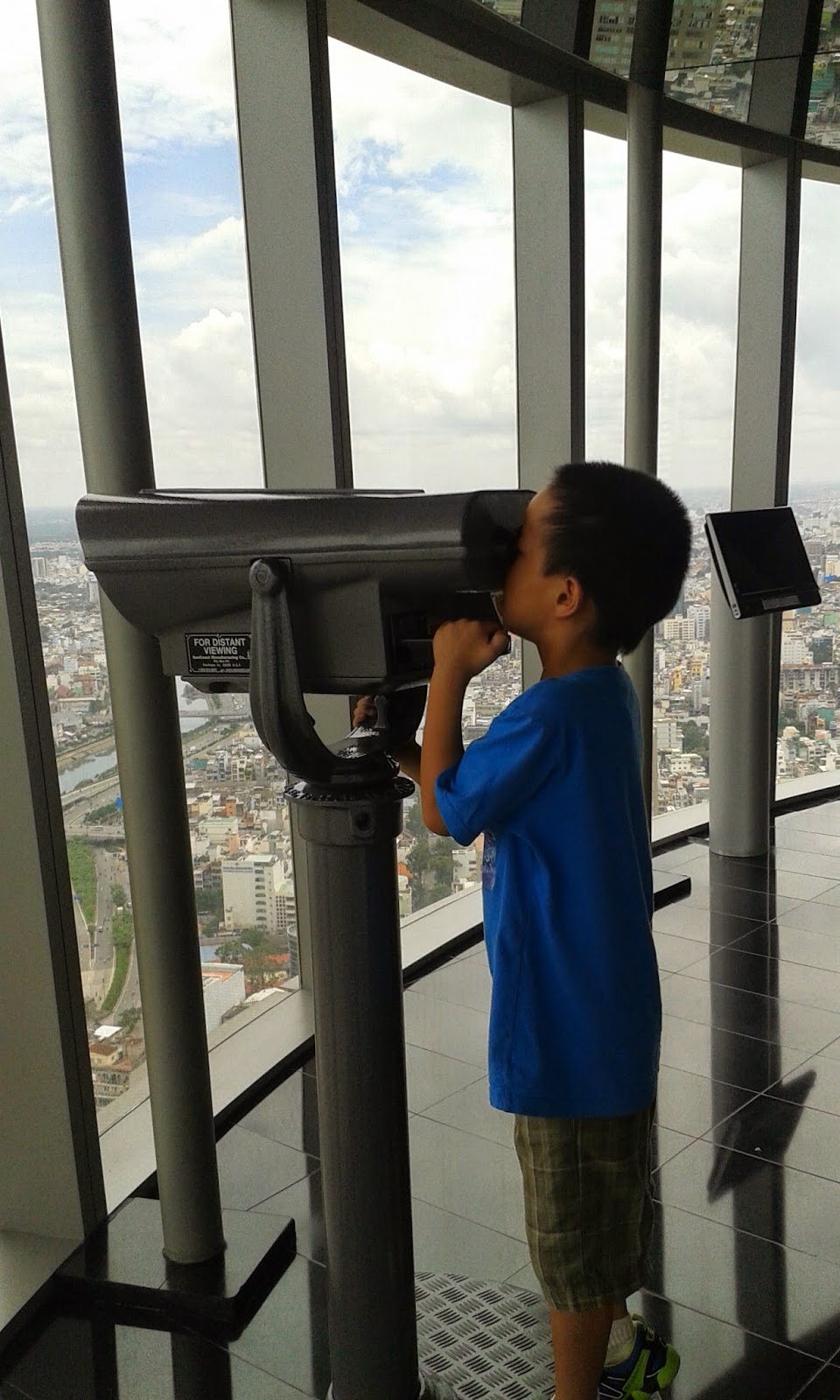
The Kiddo had a great time checking out the sites through the telescopes (which were free to use, as opposed to the pay versions you find in a lot of attractions).


The foot bridge.


 The Thuong Xa Tax department store.


The Rex Hotel.


 City Hall.


 And here are a couple more views of the Bitexco Tower from the streets.


This was a nice day trip, not too costly, and a good way to experience the city from a different perspective. More photos from the Saigon Skydeck can be found in this Flickr Album, and this album contains pictures from all over Ho Chi Minh City taken this month.


Saturday, August 23, 2014

Mekong Delta Tour

We've slowly started to see some of the sights in Ho Chi Minh City. Last weekend, we decided to head out of town.

The Mekong Delta tour is one of those prepackaged tourist things that everyone does. That being said, it ended up being pretty awesome.

Some co-workers had passed along the information for an agency that set them up on the tour the previous week. I looked at the options available on their website. There was a one-day tour to see the floating markets, but it left at 6 AM, which I was a bit iffy on after my first week at the new job.

So I ended up going to the agency's office to talk to them in person. In addition to Gynn and the Kiddo, there were two co-workers interested in going. The agency assured me that they could arrange a one-day tour private tour for five, leaving from our neighborhood in District 7 at a time of our choosing. So I decided that we should set out at the more civilized hour of 8 AM.

Our party gathered the next morning and there was some confusion with the guide trying to find our location, but after some back-and-forth, the van arrived and we were off on our first trip through the countryside.

Our guide, Nhi, was awesome, and it turns out that the tour guides are freelancers, so we got her contact information and she is going to be our first go-to person for future travel planning within Vietnam.

It was about a 2- hour drive to the Delta. We made one stop (at the "Mekong Delta Rest Stop"!), before our first actual tourist destination, a Cao Dai temple in the town that would be our river port.


Cao Dai is a relatively new religion in Vietnam that combines elements of Catholicism, Buddhism, and Confucianism. The temple was beautifully decorated.


Outside the temple in the side alley, we were like, "Look! Random dragon!"


As it turns out, the dragon was affixed to this vehicle, which Nhi explained is used in funeral processions.


Which immediately makes Vietnamese funerals way cooler than western ones. Because dragon.


After exploring the temple a bit (and Gynn buying a plant pot at a local shop), we returned to the van and headed to the river port.

We got on a boat and set out among the traffic of the Mekong.


This is a catfish-boat heading down river and out to sea:


We crossed the river and docked at a coconut candy-making place. We were used to this from some of our tours in China. There are always a few stops to give the chance to spend money. That being said, the coconut candy was delicious and not very expensive. We also got coconut rice paper, which is absolutely awesome as a crunchy snack. Here is the rice paper being made:


From there, we rode horse carts through a local village to get a snack of fruit and tea and hear some traditional music.


Fruit!


Next up we were paddled down a narrow canal back to the docking area by these awesome Mekong Delta oarswomen.


From there it was lunch time (the fruit snack and lunch were included in the cost of the tour; which was pretty reasonable at $50 per person). The main course: Elephant-ear fish from the Mekong river!


The server peeled the skin and took the meat off the fish and rolled it with rice paper and vegetables into spring rolls for us. There was tamarind sauce and chili sauce for dipping. The meal also included some deep fried spring rolls and fried rice, all quite delicious.

From there it was time to head back across the river.


We sipped some freshly-cut coconuts on the ride back to the dock and then boarded the van back to HCMC.


This trip definitely had a tourist-package vibe to it, but none of us minded. The scenery and food were lovely, and we had fun the whole day. We missed out on seeing the floating markets (they close at 10 AM, so you really do have to be up at the crack of dawn to catch those), and there is a ton more to see on the Delta, so we well definitely be back there at some point.